
Charging technology
EV Chargers With Built-In PEN Protection: UK List
On this page
UK versions of the Ohme Home Pro, Ohme ePod, Hypervolt Home 3 Pro and myenergi zappi listed below have manufacturer-documented built-in PEN-fault protection. Check the exact model and regional variant: a familiar product name does not guarantee identical protection across every version.
Last checked: 11 October 2026. This is a selected UK product list based on manufacturer documents, not a whole-market survey or hands-on safety test. Installation suitability needs a competent EV installer’s assessment; this article has not received independent electrical-professional sign-off.
Chargers with built-in PEN protection
| Charger | Version covered | Manufacturer evidence | What to check before buying |
|---|---|---|---|
| Ohme Home Pro | UK single-phase versions covered by the linked manual, including its separately documented Wi-Fi/Bluetooth variant | The Ohme installation guide specifies built-in PEN-fault detection in the Home Pro sections. | Match the supplied version to the manual. Overcurrent protection is separate, and upstream RCD requirements still need assessment. |
| Ohme ePod | UK single-phase versions covered by the same manual, including its Wi-Fi/Bluetooth variant | The same guide specifies built-in PEN-fault detection for ePod. | Confirm the exact regional version and the other protective devices required for the circuit. |
| Hypervolt Home 3 Pro | Home 3 Pro single-phase model in the manufacturer’s technical specification | Hypervolt’s specification lists integrated PEN-fault protection. | The specification also requires external AC residual-current and overcurrent protection; built-in PEN protection does not replace these. |
| myenergi zappi | ZAPPI-2Hxxx-G UK versions | myenergi’s variant guidance identifies the UK G version as having the relevant protection. | Do not treat ZAPPI-2Hxxx-T as equivalent. Its protective-earth conductor is not disconnected in the same way. Check the full product code. |
The table does not rank safety performance or transfer one model’s specification to another model from the same brand. If a charger is absent, that means this list does not cover it; absence is not evidence that the charger lacks protection.
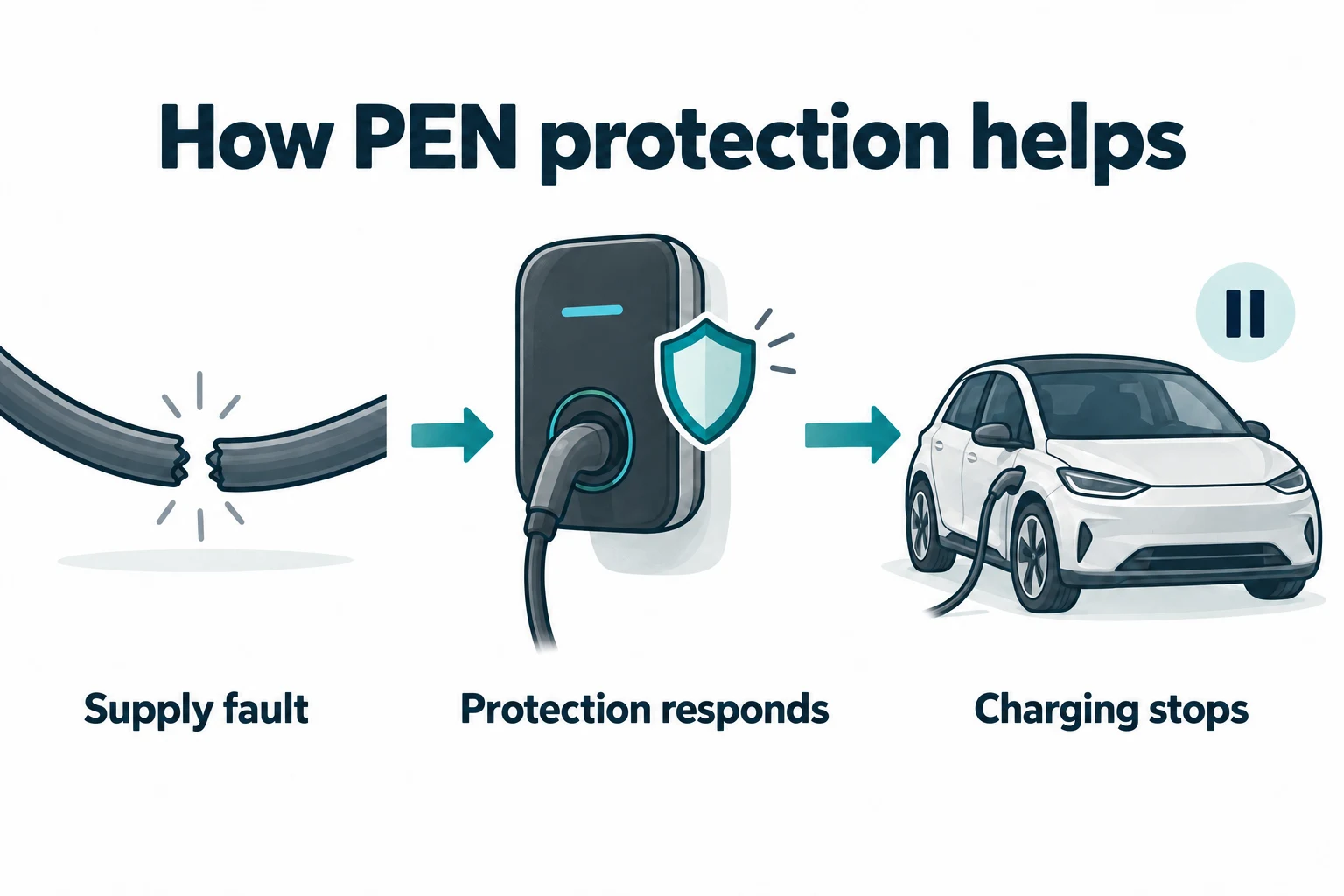
What PEN protection does
PEN refers to a conductor that combines protective-earth and neutral functions in part of the electricity supply network. A break in it can create a dangerous voltage between the ground and metalwork connected to the installation’s protective conductors, including a vehicle connected for charging.
An open-PEN protective device detects the relevant fault conditions and disconnects the vehicle as designed. It addresses a fault that can originate outside your home; it does not repair the damaged network conductor. The IET’s explanation of open-PEN detection describes this hazard and why different protection methods need careful selection.
For the wider earthing question, read our PEN protection versus earth rod guide.
Does this mean the installer can leave out an earth rod?
Do not use the table as an instruction to omit an electrode or another protective device. Ask the installer to explain the proposed earthing arrangement and how the exact charger fits it.
The IET notes that protection methods differ and that some use an electrode as part of their operation. A claim about built-in protection is therefore only one part of choosing equipment for a particular property. Solar, battery backup or other changes to the supply arrangement should be disclosed when the installation is assessed.
Useful wording for a quote request is: “Please identify the charger model, its PEN-protection arrangement and any external protection or earthing work included in the installation.”
Built-in PEN protection is not every kind of protection
Three terms often appear beside each other on a specification sheet:
- PEN-fault protection concerns the supply fault described above.
- Residual-current protection, including the treatment of DC leakage, is a separate requirement.
- Overcurrent protection addresses overload and short-circuit conditions.
Hypervolt’s specification makes the distinction practical: the Home 3 Pro has integrated PEN protection, but external AC residual-current and overcurrent protection remain necessary. Ohme’s manual also separates its PEN function from the other circuit requirements. Neither supports treating the wallbox as a complete replacement for the installer’s protective-device design.
What to ask before accepting a quote
Ask for the full model or part number, the applicable installation manual, and a clear explanation of any external equipment. If a quote includes an additional PEN device despite the charger’s built-in protection, ask why it is needed for your installation rather than assuming it is either essential or unnecessary.
Then compare the features that affect daily use: cable arrangement, parking position, connectivity and charging controls. PEN protection is an installation consideration, not a reason on its own to choose one app or cable length over another.
Use our EV charging technology hub for the surrounding installation questions, and take the shortlist to a competent EV installer before ordering.
Common questions
Which EV chargers have built-in PEN protection?
Manufacturer documentation confirms it for the UK Ohme Home Pro and ePod variants covered here, Hypervolt Home 3 Pro, and myenergi zappi ZAPPI-2Hxxx-G UK versions. This is a selected list, not every charger on the market. Confirm the exact unit against its installation manual before ordering.
Does built-in PEN protection mean no earth rod is needed?
It can remove the need for a separate PEN-protection arrangement in a suitable installation, but it is not a blanket exemption from earthing requirements. Your installer must assess the supply, location and manufacturer's instructions before deciding what the installation needs.
Is PEN protection the same as an RCD?
No. Open-PEN protection addresses a particular supply-network fault. Residual-current protection addresses a different electrical hazard. A charger having one does not establish that all the other required protection is present.
Is a charger without built-in PEN protection unsafe?
That specification alone does not tell you whether a complete installation is safe. An appropriate external protective device or other suitable design may provide the required protection. A competent EV installer must assess the whole installation.