
Buying guide
Zappi vs Hypervolt: Solar Charging Compared
On this page
Both myenergi zappi and Hypervolt Home 3 Pro can follow surplus solar. Shortlist the screen-equipped zappi if you want its adjustable ECO+ behaviour or a socketed option. Shortlist Hypervolt if a longer attached lead or its Battery-Safe mode fits your requirements. With a home battery, the whole system’s setup matters more than the solar-compatible label.
This comparison covers the UK screen-equipped zappi 2H family, using single-phase charging for the solar examples, and Hypervolt Home 3 Pro with a Type 2 lead. Zappi GLO is a separate model. Manufacturer and supplier documentation was checked on 8 October 2026. We have not installed or hands-on tested these chargers; our shortlist advice follows from documented features.
Zappi vs Hypervolt at a glance
| Decision | myenergi zappi | Hypervolt Home 3 Pro |
|---|---|---|
| Connection choices | Type 2 socket or 6.5m attached lead | Attached Type 2 lead: 5m, 7.5m or 10m |
| Supply options | Single-phase or three-phase variants | Single phase, rated up to 7.4kW |
| Everyday controls | App, screen and front buttons | App and status lighting |
| Solar with grid top-up | ECO | Eco |
| Surplus-led charging | ECO+; Minimum Green Level determines permitted grid contribution | Super-Eco; can also draw stored battery energy |
| Battery consideration | Different settings for AC-coupled and hybrid storage | Battery-Safe pauses charging to help avoid unwanted battery discharge |
| If you need the car charged sooner | FAST or a boost | Boost |
Hardware details come from the zappi UK data sheet and Hypervolt Home 3 Pro specification. Confirm the exact variant in your quote. Three-phase hardware does not make a single-phase supply or an incompatible car charge faster.
Choose what happens when a cloud passes
Both chargers distinguish keeping a session running from waiting for enough surplus. In their Eco modes, charging can continue with a grid contribution when solar is insufficient. That can suit a driver who needs dependable progress towards the next journey.
Zappi’s ECO+ gives you an adjustable Minimum Green Level. At 100%, charging pauses when there is insufficient surplus; lowering it permits a grid contribution. Its start/stop delay also helps avoid reacting to every brief fluctuation. A scheduled or manual boost overrides the surplus-led routine. See myenergi’s charging-mode explanation.
Hypervolt’s Super-Eco waits for roughly 1.4kW of surplus. Its separate Battery-Safe mode needs about 1.9kW to start, according to the manufacturer. That higher threshold may matter when modest surplus is common. Super-Eco can use home-battery energy, so selecting it alone does not reserve stored electricity for later household use. See Hypervolt’s mode guidance.
For either choice, think about a cloudy weekday: can charging wait, or must the car be ready at a specific time? Ask for a demonstration of that routine, including how an urgent charge changes the energy source.
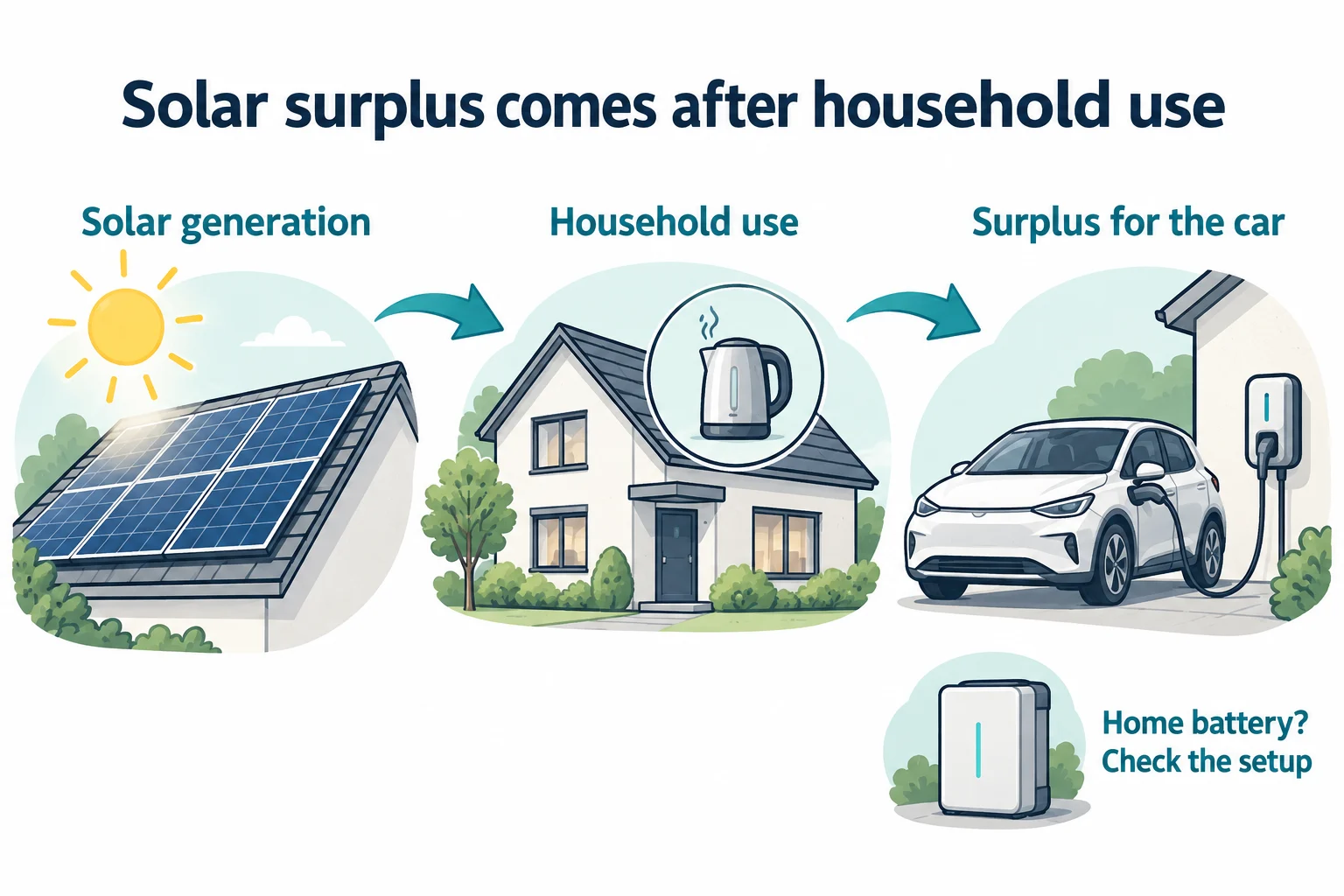
Surplus is not your solar array’s rated output
The house uses some generation before any surplus is available to the car. A panel system’s advertised size therefore does not tell you how often surplus-only charging will start. Look at your actual daytime export pattern and whether the car is home during those hours.
The measurement equipment matters. Myenergi explains that zappi relies on its grid CT sensor for surplus control; a separate PV sensor is useful for showing generation in the app but is not itself required for that control. Ask the installer to distinguish essential sensing from optional monitoring in the quotation. See myenergi’s grid and solar sensor guidance.
Hypervolt requires its primary CT for household energy-flow measurement. A second CT can add battery monitoring for an AC-coupled system, but the manufacturer says it is not required for Battery-Safe itself. See Hypervolt’s home-battery setup guidance. Sensor installation and commissioning are jobs for the installer; this comparison is not a wiring guide.
A home battery changes the comparison
An inverter can see EV charging as household demand and discharge the battery to meet it. That may be useful when intentional, but it defeats a plan to save stored electricity for the evening.
For zappi, myenergi distinguishes AC-coupled storage from a hybrid inverter sharing solar and battery output. An additional battery CT supports its avoid-drain settings with suitable AC-coupled systems. With a hybrid inverter, the charger cannot separate solar from battery output in the same way; myenergi instead describes an export margin. FAST charging and boosts need particular care because the storage system may supply them. See myenergi’s third-party-battery guidance.
Hypervolt offers Battery-Safe, but explicitly says it does not directly control the battery’s charging or discharging. Its guidance also discusses inverter settings and installer assessment of the system layout. That is a reason to verify the complete arrangement rather than treat a mode name as a guarantee. See Hypervolt’s explanation of unwanted battery drain.
Give the installer your inverter and battery model names. Ask them to demonstrate surplus charging, an urgent charge and overnight charging, and to explain which behaviour preserves stored energy. Do not move sensors or change electrical connections yourself.
Solar charging is not automatically the cheapest option
Using generation in the car avoids buying that energy, but may give up export income. Compare the export payment you would forgo with the import price you would otherwise pay, using your own tariff and a consistent treatment of charging losses.
If your overnight import price is below your export payment, exporting by day and charging overnight may be financially preferable. If import costs more than the export income lost, self-consumption may be preferable. Those are conditional comparisons, not a universal recommendation; battery use and the rest of the household bill can change the result.
Octopus lists both zappi and Hypervolt in its charger connection guidance for Intelligent Octopus Go. Check the exact hardware and eligibility before buying, and confirm how supplier-managed charging works alongside your solar settings. Avoid conflicting vehicle, charger and supplier schedules. Our smart-charger cost guide explains the wider bill comparison.
Make the shortlist from your parking and routine
Choose zappi for further assessment if a removable cable, local screen or adjustable ECO+ setting solves a practical need. Choose Hypervolt for further assessment if its longer attached-cable options or Battery-Safe controls fit your requirements. Neither recommendation claims superior reliability, app quality or measured solar yield; we have not tested those.
Compare complete installed quotes covering the exact charger, cable, sensors, network connection, commissioning and VAT treatment. Ask what the survey could add. A dated hardware price on a model page is not an installed quotation.
Explore the zappi model specifications, Hypervolt Home 3 Pro specifications and Hypervolt vs Ohme comparison for other documented differences. Return to our EV charger buying guides for the parking, supply and cable checks before ordering.
Common questions
Can Zappi and Hypervolt both charge from surplus solar?
Yes, with the required sensing and setup. Zappi ECO+ at 100% Minimum Green Level and Hypervolt Super-Eco are the relevant surplus-led modes. Hypervolt Super-Eco can also use home-battery energy; keeping stored energy for the house requires a separate battery check.
How much spare solar power does charging need?
For the single-phase charging compared here, the manufacturers describe roughly 1.4kW of surplus for Zappi ECO+ at 100% Minimum Green Level and Hypervolt Super-Eco. Hypervolt lists around 1.9kW to start Battery-Safe. These refer to available surplus after household use, not the panels' nameplate rating.
Will either charger always stop my home battery draining?
Do not assume that. Zappi's third-party-battery settings depend on whether storage is AC-coupled or hybrid. Hypervolt offers Battery-Safe but does not directly control the inverter. Have the installer verify behaviour with your exact battery during both solar and scheduled charging.
Do I need solar panels to use either charger?
No. Both support grid charging. Solar modes are additional choices; they do not replace the need to check the electrical installation, connection and daily charging requirements.