
Buying guide
Is a Smart EV Charger Worth the Extra Cost?
On this page
A smart EV charger can be worth the installation cost if it helps you move enough charging onto cheaper electricity. Paying more for a premium charger is a different calculation: if a cheaper model gives you the same tariff and charging routine, the expensive one does not automatically save more money.
Start with what you already have. Someone installing their first home chargepoint, someone replacing a working wallbox and someone choosing between two new models should not use the same payback calculation. The relevant cost is the money each decision adds, and the relevant saving is the difference from the option they could actually use instead.
This guide uses tariff information rechecked on 8 October 2026 and labelled calculation assumptions. The examples are not installer quotations, measured household results or promises about future energy prices.
Is “smart” still an optional upgrade?
For most new home wallboxes sold in Great Britain, smart functionality is already part of the baseline. The government’s smart chargepoint guidance covers private domestic and workplace chargepoints sold from 30 June 2022, with specified exceptions. Northern Ireland is outside these regulations.
That changes the buying question. You will often be comparing two smart chargers with different features, rather than choosing whether to pay for basic smart capability at all. A higher price might buy a different cable arrangement, interface, connectivity option or energy-management feature. Check the exact model specification to see what the difference buys you.
The rules also require supplier interoperability, but that does not mean every charger qualifies for every supplier’s managed charging tariff. Retaining smart functionality after switching supplier and supporting a particular tariff integration are separate things. Confirm the latter with the supplier before ordering hardware.
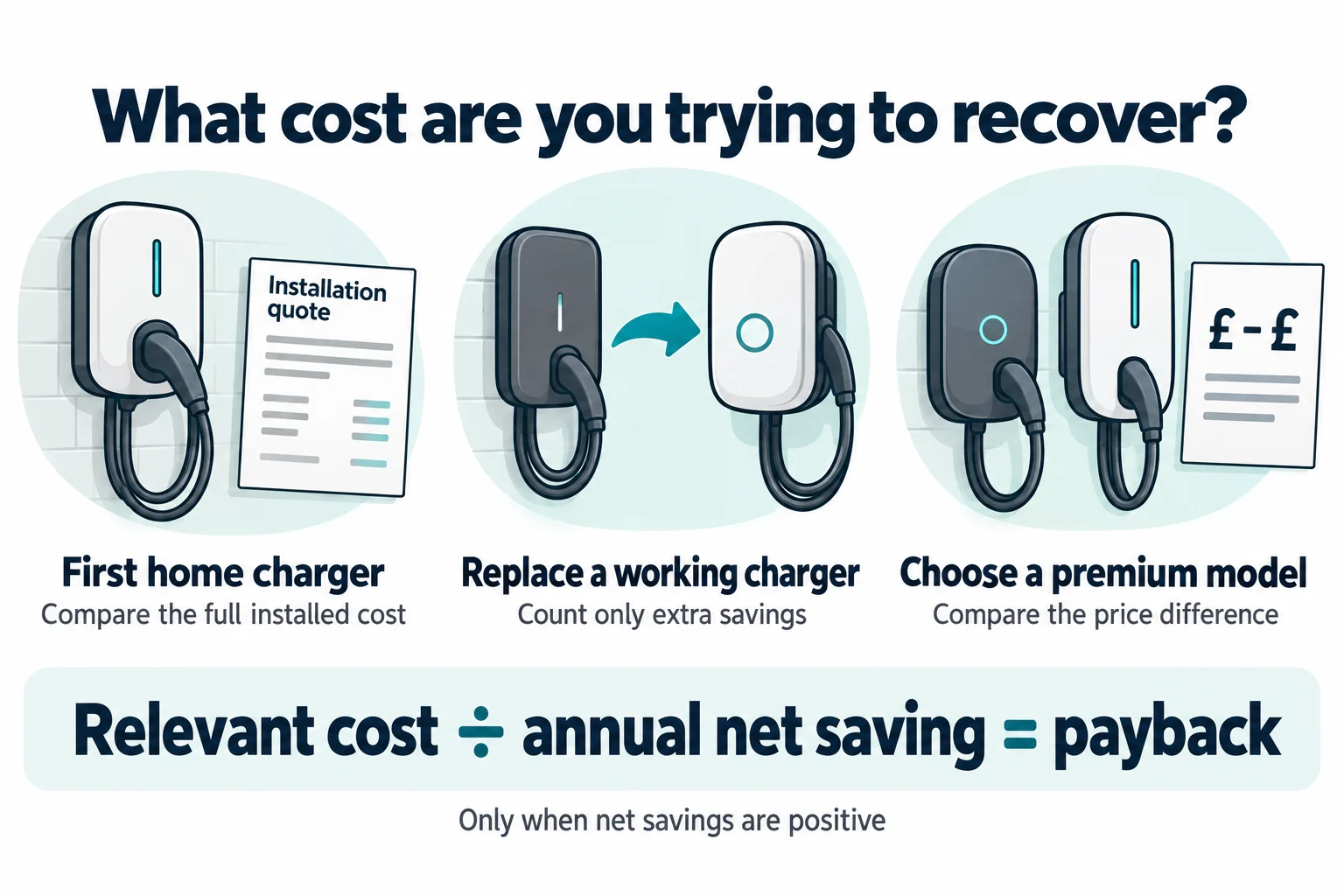
Choose the right cost to recover
Write down your actual alternative before calculating any return.
| Your decision | Cost to put into the calculation | Saving to compare against it |
|---|---|---|
| Install your first home chargepoint | Complete installed price, after any confirmed funding | Difference from the charging arrangement you would otherwise use |
| Replace a working charger | Replacement, installation and any associated work | Extra savings available beyond your existing setup |
| Choose a premium model | Difference between comparable installed quotes | Benefits and savings that only the dearer option provides |
Use quotes with the same scope. Hardware alone is not comparable with a price that includes installation. Ask whether the total covers the necessary electrical work, cable route, commissioning and any accessories you require. Count finance costs or recurring fees if they apply to your chosen arrangement.
For example, a £1,000 installation and a £1,250 alternative have a £250 price difference. Those are illustrative amounts, not market prices or quotes. If you need a charger either way, the premium model has to justify that £250 difference; it should not receive credit for savings the £1,000 option would also deliver.
Check whether your existing equipment can get cheaper electricity
A new wallbox is not always the thing that unlocks a lower rate. Octopus Go, for example, offers a fixed overnight window and lists compatibility with all EVs and chargers, alongside its account and smart-meter requirements. Its page says a home EV charger is not required to join.
Managed charging works differently. With Intelligent Octopus Go, the supplier connects to a supported car or charger and schedules charging. Check the combination in its eligibility tool: an unsupported car may work through a supported charger, while a supported car may avoid the need to change the charger.
On 8 October 2026, the page advertises eligible smart charging from 7.6p/kWh, with up to six hours of smart charging per day and a six-hour household overnight window. Day rates require a postcode quote. The page currently offers fixed rates with a £50 early exit fee; check the terms that apply to your quote and any urgent charging outside the discounted arrangement.
These are examples of two different tariff arrangements, not a recommendation that either is cheapest for your home. Check your meter, vehicle, charger and charging schedule against the supplier’s requirements. Then compare the entire electricity bill, including the hours when you are not charging the car.
A worked example using October 2026 rates
Ofgem’s published electricity figures show 26.32p/kWh as the Great Britain Direct Debit average for 1 October to 31 December 2026. Your regional rate can differ. Use this published rate directly, without another VAT adjustment.
Comparing that average with the advertised 7.6p eligible smart-charging rate gives 18.72p per kWh. These are an average and a headline tariff example, not two personal quotations. For the calculation below, assume:
- All the listed mileage is powered by electricity bought at home.
- The car travels four miles per billed kWh. This is an illustrative meter-to-road assumption, including charging losses, not a claimed average vehicle efficiency.
- All that charging moves from the standard rate to the eligible cheap rate.
- The installation costs £1,000, purely as a worked example.
- Rates remain unchanged for the calculation; household tariff differences and other costs are assessed separately below.
| Annual miles powered from home | Electricity bought for the car | Annual charging-energy saving | Simple payback on £1,000 |
|---|---|---|---|
| 4,000 | 1,000 kWh | £187.20 | 5.3 years |
| 8,000 | 2,000 kWh | £374.40 | 2.7 years |
| 12,000 | 3,000 kWh | £561.60 | 1.8 years |
| 16,000 | 4,000 kWh | £748.80 | 1.3 years |
For the 8,000-mile row, the arithmetic is 8,000 ÷ 4 = 2,000 kWh; 2,000 × £0.1872 = £374.40; £1,000 ÷ £374.40 = about 2.7 years. These are simple payback figures, without financing or discounting future savings.
The table illustrates the value of moving electricity to a cheaper rate. It only supports the case for buying a charger if that purchase is necessary to achieve the change. If your existing equipment can already deliver it, the tariff saving cannot justify replacing that equipment.
Adjust the example to your real charging
Use billed charging energy where you have it. A vehicle’s dashboard efficiency may exclude energy lost during charging, whereas the electricity account bills the energy drawn from the supply. Avoid combining those measures without accounting for the difference.
Count only the charging affected by your decision. If some miles are powered by free workplace charging, they do not create a home-tariff saving. Public charging may still be needed on journeys after you install a wallbox; do not assume the whole public-charging bill disappears.
Your parking routine matters too. Cheap hours are useful only when the car can be connected and receive the required energy. Check the available window against your normal arrival and departure times. Use the charger’s and vehicle’s supported power, rather than assuming the highest rating advertised on either device is always delivered.
If only half the example energy moves to the cheap rate and the other half stays at the original rate, the energy saving halves. If the remaining charging instead attracts a different day rate, calculate that portion separately. Occasional urgent charging should be included where it reflects your routine.
Include the rest of the household bill
The car can become cheaper to run while the rest of your electricity becomes more expensive. Compare annual totals, not just the attractive overnight number.
Take the £374.40 charging saving above. Suppose, as an illustrative scenario, your non-EV daytime use is 2,500 kWh a year and the new day rate is 3p/kWh higher. That adds £75. If the new standing charge is also 5p a day higher, it adds £18.25 over 365 days.
The remaining annual saving is £374.40 − £75 − £18.25 = £281.15. A £1,000 installation would then take about 3.6 years to recover, before any other costs. These assumed differences do not describe a quoted Octopus tariff.
Your result could improve if household use also shifts into cheaper hours. It could worsen if little charging happens at home or the daytime premium is larger. Use the same annual consumption under both alternatives so the comparison remains fair.
When does the premium model pay back?
Consider the illustrative £250 upgrade. If it enables an additional £50 of net annual savings that the cheaper model cannot provide, its simple payback is five years. If it produces no extra saving, there is no financial payback from electricity costs.
That does not make every premium feature pointless. A better cable arrangement, easier controls or a feature you need may be worth paying for as a convenience. Our guide to leaving an untethered cable connected explores one practical choice that can affect your daily routine.
Treat solar savings separately. If charging the car uses electricity you would otherwise export, include the lost export payment when comparing options. Do not credit a charger with the full retail value of that electricity while ignoring the alternative income. Confirm how the proposed equipment works with your solar and battery setup before assigning it any saving.
Make the decision from your numbers
Use this calculation: relevant upfront cost ÷ annual net saving = simple payback in years. Annual net saving should include the change in charging costs, the change in other household electricity costs, standing charges and any recurring fees. If the result is zero or negative savings, there is no positive payback to calculate.
Before buying, obtain a complete installed quote, confirm tariff eligibility for your exact equipment and compare your likely annual bill under each option. Recalculate using the rates available when you order, especially around a scheduled tariff change.
A first home charger may earn its place through lower charging costs and convenience. Replacing a working charger or choosing a more expensive one needs an additional benefit. Use our EV charger buying guides to consider the practical features alongside that calculation, then pay for the combination you will actually use.
Common questions
Will a smart EV charger automatically lower my electricity bill?
No. Savings depend on your tariff, when charging happens and the electricity you buy. If you already charge the same amount at the same cheap rate, changing the wallbox alone does not create a new unit-rate saving.
Do I need to replace my charger to get an EV tariff?
Not necessarily. Some tariffs provide a fixed overnight window without requiring a particular charger integration. Others can control a compatible car or charger. Check the supplier's current requirements for your exact equipment before buying a replacement.
How long does a smart charger take to pay for itself?
Divide the relevant upfront cost by the annual net saving. In our illustrative 8,000-mile scenario, a £1,000 installation takes about 2.7 years to recover from charging-energy savings alone. This holds the October 2026 example rates constant and excludes changes to the rest of the household bill; it is not a forecast or quotation.
Is a premium charger worth it if both models support my tariff?
Compare the extra price with benefits the cheaper option lacks. If both deliver the same charging at the same rate, tariff savings do not repay the premium. Cable reach, controls, support and any verified solar features may still justify it for your household.