
Buying guide
EV Charger Cable Stolen: Can It Be Replaced?
On this page
A stolen detachable EV charging cable can usually be replaced without replacing the wall charger. If a thief has cut the cable from a tethered charger, the unit needs professional assessment before it is used again. Whether that means a new cable assembly or a replacement chargepoint depends on the model and damage.
Start by identifying what is missing. A lead that plugged into a socket on your wallbox is a different purchase from the cable permanently attached to it. Ordering the wrong one can leave you with a perfectly usable accessory that does nothing to repair your charger.
First, stop using damaged equipment
If a cable has been cut or pulled out, keep people away from the damaged equipment and do not touch exposed conductors. Do not try another charging session to see whether the wallbox still works. Arrange for a qualified electrician to make it safe and assess the damage.
An app showing that charging has stopped is not a substitute for electrical isolation. Do not open the enclosure, join the remaining cable to another lead, or treat tape as a repair.
For example, myenergi’s zappi GLO safety guidance tells owners to stop using a damaged unit and reserves repairs for qualified installers using approved parts. Follow the instructions for your own model rather than assuming all chargers have the same repair procedure.
If only a detachable lead is missing, look for visible damage to the wallbox socket and vehicle inlet without touching their contacts. Broken casing, displaced parts or signs that a plug was forced out are reasons to arrange an inspection before reconnecting.
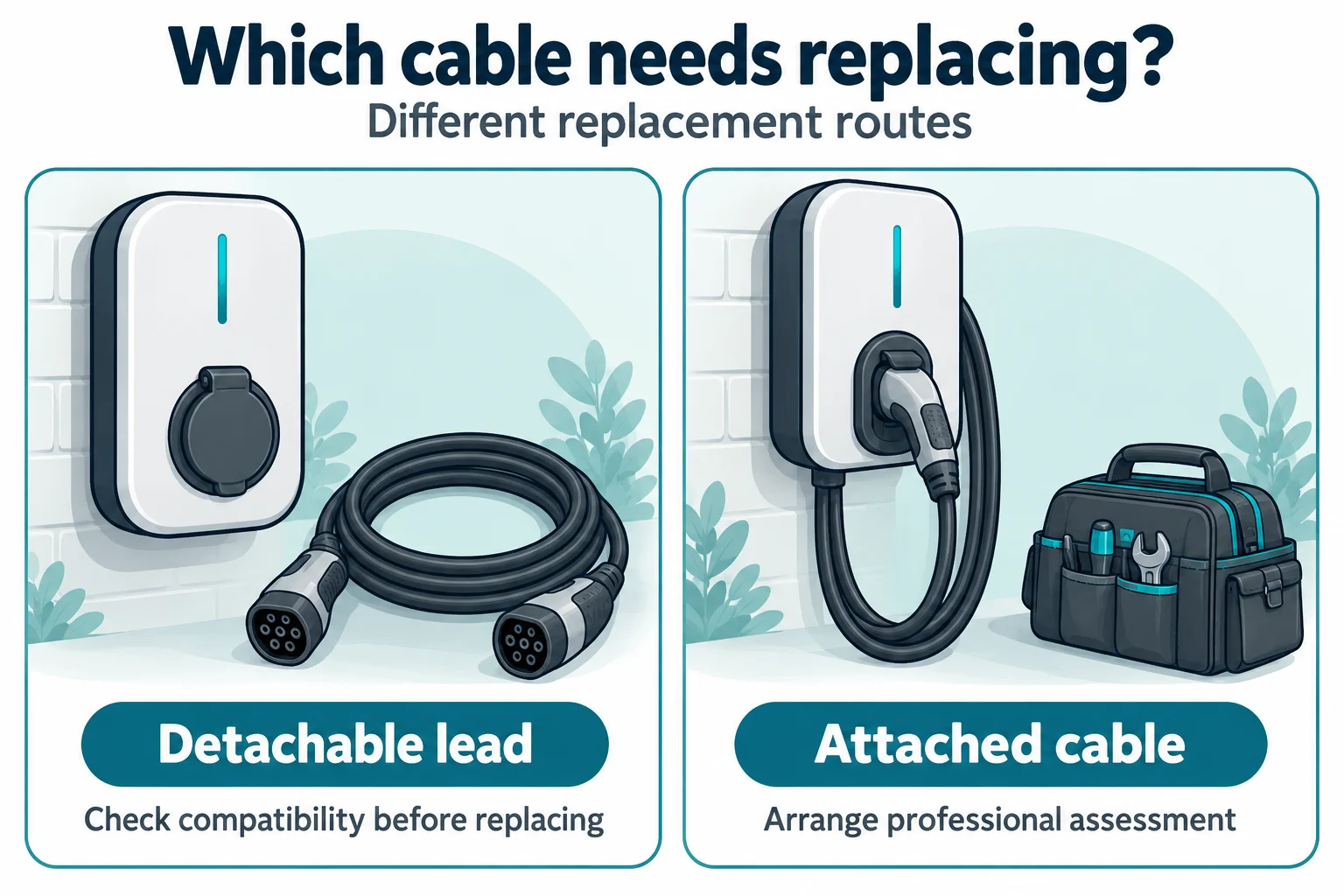
Which replacement route applies?
| What happened? | First contact or purchase | What needs checking? |
|---|---|---|
| A detachable lead disappeared; neither socket appears damaged | A compatible replacement charging lead | Both connectors, current rating, phase capability and length |
| A detachable lead was forcibly removed | Charger support or a qualified electrician; vehicle support if its inlet is damaged | The sockets and locking mechanisms, as well as the missing lead |
| The cable was cut from a tethered wallbox | Manufacturer support or the original installer | Whether an approved cable repair is available for that model |
| The whole wallbox was removed or damaged | An electrician, plus the owner or insurer | Making the supply safe and assessing a replacement installation |
| A shared or public charger’s cable was cut | The chargepoint operator or property manager | Reporting the fault and preventing further use |
The useful question is: what must be replaced to restore safe charging? The missing cable’s appearance alone cannot answer that after a forced removal.
Replacing a detachable cable
A socketed, or untethered, home charger uses a separate lead. If the chargepoint and car remain undamaged, replacing that lead does not ordinarily require a new wallbox installation.
Check the car manual and charger documentation before ordering. Pod’s cable-selection guide explains the main checks: the vehicle-side connector, length and current rating.
- Connectors: a Type 2 socketed chargepoint needs a Type 2 connector at that end. Match the other end to the car’s AC inlet: Type 2 or, on some vehicles, Type 1.
- Rating: match the cable to the charging arrangement. Pod identifies 32A as approximately 7.4kW on single-phase AC; a cable’s headline kW figure alone does not establish compatibility.
- Phases: check whether the cable supports the single-phase or three-phase charging you intend to use.
- Reach: measure the normal route between the socket and car, allowing comfortable slack. Avoid choosing a lead that only reaches when stretched.
Before paying, send the supplier the vehicle model, chargepoint model and the proposed cable specification if anything is unclear. Ask for written confirmation of suitability and keep it with the receipt. That is more useful than relying on a listing that simply says “universal”.
Replacing a tethered cable
A tethered cable is part of the charger assembly. A loose lead intended to plug into a public AC socket is not automatically an approved spare part for that wallbox.
Ask manufacturer support to identify the repair route using the model and serial number. Request confirmation of the replacement part, who may fit it, and what inspection and testing the work includes. Avoid buying a part first and then trying to find someone willing to install it.
The answer may be a supported cable replacement, a service visit, or a replacement unit. Do not assume that another owner’s repair applies to a different model or generation. Equally, a cut cable does not by itself prove that every part of the installation must be replaced.
Ask the installer to explain their recommendation in writing. If they recommend a whole new charger, ask whether that is because of additional damage, unavailable approved parts, or the overall repair cost. These are different reasons and help you compare the options.
What should a replacement quote include?
There is no single useful price covering both a loose lead and a damaged tethered charger. For a detachable cable, compare the same connector arrangement, electrical specification and length. Check the delivered total and returns terms, rather than comparing only the first price shown.
For a repair, request an itemised quotation covering:
- The approved replacement cable or charger, identified by model or part number.
- Assessment and call-out charges, including whether these are credited against the repair.
- Labour and any additional damaged components.
- Inspection, testing and the record you will receive when work is complete.
- VAT, travel or delivery charges, and the warranty on the supplied parts and work.
Also ask when the equipment can be used again and whether the quoted visit includes completing the repair. An assessment-only booking and a repair booking are not equivalent offers.
Keep the original quote and any revised estimate. If further damage is found, ask for the extra work and cost to be explained before agreeing. This is especially useful when an insurer, landlord or leasing provider is involved in authorising expenditure.
Could insurance pay for it?
Check your actual policy before deciding that the loss is covered, or that it is excluded. A detachable accessory and a fixed wallbox may be treated differently, and the location of the equipment can matter.
For example, Aviva’s current electric-car insurance page describes cover for charging accessories in the vehicle, in use or stored in a private garage. It also describes garage-installed wallbox cover under comprehensive insurance. That is a reason to check your motor policy, not a promise that every cable theft or driveway wallbox is covered.
Ask your insurer to confirm the relevant section, excess, evidence required and whether it needs to approve the supplier before you buy. Describe exactly what was taken, where it was, and any damage left behind. Keep the police reference, photographs taken from a safe distance, receipts and repair quotation together.
If the equipment belongs to a landlord, employer or leasing provider, contact that owner before arranging its replacement. Do not assume that a charger supplied with a vehicle is yours to modify.
What to send the installer or manufacturer
A clear first message can avoid a series of requests for missing information. Include:
- The charger manufacturer, model and serial number, obtained without opening the unit.
- Whether the cable was detachable or permanently attached.
- What you found: a missing lead, a cut cable, a damaged socket or a missing wallbox.
- Photographs of the exterior and visible damage, taken without approaching exposed wiring.
- The installation date and original invoice, if available.
- Any insurer or equipment-owner requirements already confirmed.
Finish with a specific request: “Please confirm whether an approved cable replacement is available for this model, and quote for assessment, parts, fitting and testing.”
If the property has shared charging, give the operator the unit’s identifier and location. Report the damaged equipment rather than trying to repair or reset it yourself.
Charging while you wait
Check for a compatible public chargepoint with its own attached lead. A DC rapid charger supplies its cable, but confirm that your vehicle supports its connector and DC charging before travelling. Not every plug-in vehicle does. Socket-only AC points still require your own lead.
Choose a backup location before the battery becomes low, and check access, payment arrangements and current availability with the operator. A location marked on a map is not a guarantee that a suitable charger is working or accessible when you arrive.
For longer-term budgeting, our guide to charging costs over 400 miles explains how to compare charging methods. Use the tariff currently displayed by the operator for your immediate journey.
Reducing the chance of another theft
For a detachable lead, secure storage between uses removes the need to leave it exposed at the chargepoint. If you prefer to leave it connected, check whether your model offers a lock that stays engaged after charging ends. Our guide to leaving an untethered charging cable plugged in explains the lock settings and storage checks to make first.
Zaptec’s cable-lock instructions describe a setting that retains the cable between sessions. It requires the appropriate owner access and an online charger to operate the setting. Other manufacturers may behave differently, so check your own instructions.
A socket lock addresses unplugging; it cannot make exposed cable impossible to cut. Keep purchase records and identifying details for a replacement, and consider how the parking area is monitored and how you store the lead when it is idle.
For the broader choice between charger arrangements, start with our EV charger buying guides. For this replacement, the first decision remains simple: establish whether you need a compatible detachable lead or a professionally assessed repair.
Common questions
Can I replace a stolen charging cable myself?
You can buy a compatible detachable lead for an undamaged socketed charger. A cable cut from a tethered charger is different: stop using the unit and ask its manufacturer or an EV-chargepoint electrician about the approved repair route. Do not open the charger yourself.
Does the replacement cable have to match the charger brand?
A detachable cable does not generally need the same brand name, but its connectors, electrical rating and intended use must suit the car and chargepoint. A tethered replacement must be approved for the exact charger model; a loose cable advertised for public charging is not automatically a suitable repair part.
Will a locked charging cable still be vulnerable to theft?
Locking can prevent normal unplugging, but it does not make the exposed cable impossible to cut. Check whether your charger keeps the cable locked between sessions, and store a detachable lead securely when it is not needed.
Can I still charge at a public charger without my own cable?
Yes, if the chargepoint has an attached cable compatible with your car. DC rapid chargers have attached leads, but your vehicle must support the connector and DC charging. A socket-only AC chargepoint still needs a compatible detachable cable.