
Buying guide
What It Costs to Charge an EV for 400 Miles
On this page
The cost of 400 miles depends on the car’s efficiency, charging losses and the price of electricity. Comparing tariffs only works if you use the same energy assumptions and distinguish electricity reaching the battery from electricity you pay for.
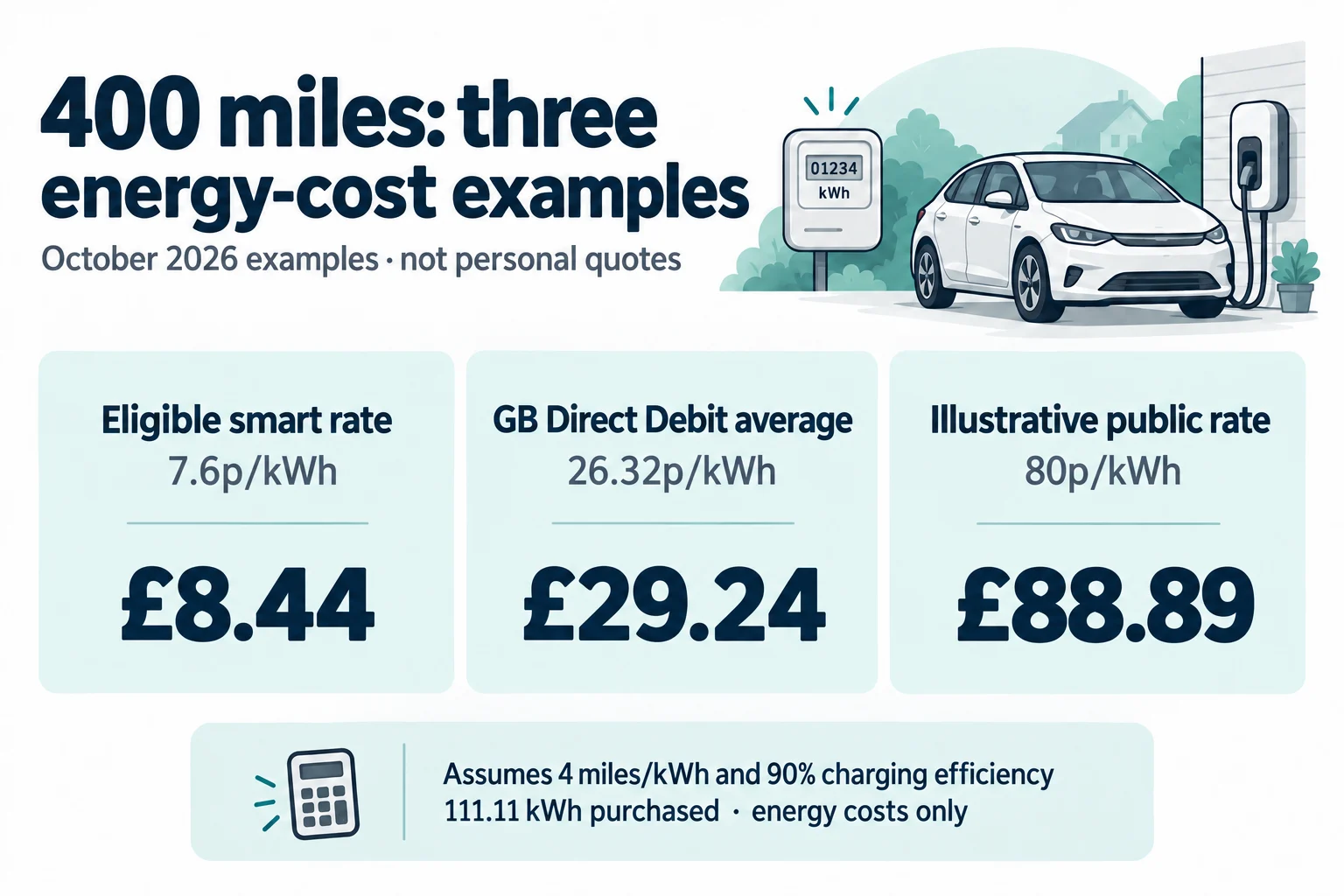
A transparent worked example
For illustration, assume 4 miles per kWh used by the car and 90% charging efficiency. These are calculation inputs, not measured averages or claims about a particular charger.
- Energy used by the car: 400 miles ÷ 4 = 100 kWh.
- Electricity purchased with the assumed losses: 100 ÷ 0.90 = 111.11 kWh, rounded.
- Cost: purchased kWh × price in pounds per kWh.
If your measured miles-per-kWh already includes charging losses at the billing meter, do not apply the loss adjustment again. For public charging, use the energy billed by that operator rather than assuming its losses equal those of a home AC session.
| Price scenario | Unit price | Worked cost for 111.11 kWh |
|---|---|---|
| Ofgem Direct Debit average, October–December 2026 | 26.32p/kWh | £29.24 |
| Intelligent Octopus Go advertised eligible smart-charging rate, checked 8 October 2026 | From 7.6p/kWh | £8.44 at 7.6p |
| Illustrative public charging rate, not a market average | 80p/kWh | £88.89 |
Sources checked 8 October 2026: Ofgem’s unit-rate table and Intelligent Octopus Go. Ofgem’s figure is a Great Britain Direct Debit average, not your individual quote. The Octopus page advertises eligible smart charging from 7.6p/kWh; obtain a quote and check eligibility, charging allowances, day rates and current terms. The 80p public rate is a chosen example: replace it with the operator’s displayed price. Calculations use the unrounded 100 ÷ 0.90 kWh input before rounding the final cost.
For historical context, the September example used 26.11p/kWh and 8.4p/kWh, giving £29.01 and £9.33 respectively under the same assumptions. Those are dated examples, not current tariff offers. Ofgem’s current table states that electricity has no VAT from 1 October 2026 to 31 March 2027; use the published rate without applying another tax adjustment.
Off-peak tariffs are not all the same
Octopus Go is a fixed-window example whose page lists compatibility with all EVs and chargers, subject to its account and meter conditions. A timer in the vehicle can be relevant; buying a specific new charger is not a universal prerequisite.
Supplier-managed charging is different. Intelligent Octopus Go needs a supported vehicle or charger and the supplier’s control arrangement. Check your combination, charging allowance, daytime price and immediate-charge terms. Do not count all your charging at the cheapest rate if some happens outside it.
Include the rest of the household bill
The table compares energy for driving only. Standing charges, daytime household consumption, public parking/session fees and subscriptions can change the overall result. Compare the whole bill before switching tariffs, not just one attractive overnight price.
In winter or at motorway speeds, use your own observed efficiency rather than assuming this example’s 4 miles per kWh. For illustration, at 3 miles per kWh and the same 90% efficiency, 400 miles requires 148.15 purchased kWh instead of 111.11.
Solar has an opportunity cost
Electricity used by the car may otherwise have earned export income or served another household load. Compare that forgone income with the import cost avoided, and check how the charger interacts with a home battery. The financial answer depends on your tariffs and setup, not simply whether solar panels are fitted.
See whether a smart charger is worth its cost for a separate payback example, and our buying guide for the steps before choosing hardware.
Common questions
Do I need a particular smart charger for off-peak electricity?
Not for every tariff. A fixed-window tariff may work with a vehicle timer, while supplier-managed charging needs a supported car or charger. Check the specific tariff’s eligibility and meter requirements.
Does 7kW versus 22kW change the price per kWh?
The tariff sets the unit price. Charging power affects how long the session takes and whether it fits a cheaper window; supply, car limits and charging losses also matter.
Is solar charging free?
It avoids buying that portion of energy, but may forgo export payments. Compare export income with the import cost avoided, allowing for system losses and other household uses.
Are these figures a prediction of my bill?
No. They are worked examples with explicit assumptions. Substitute your electricity rate and measured energy use, and include standing-charge changes or public parking/session fees where relevant.