
Buying guide
Can You Leave an Untethered EV Cable Plugged In?
On this page
You can leave a detachable cable connected between charging sessions where both the charger and cable instructions allow it. Some socketed chargers offer a permanent cable-lock setting, but that setting alone is not permission to leave every cable outside indefinitely.
The attraction is straightforward: leave the wallbox end in place, park the car, and connect the other end. You avoid packing away the lead after every charge while retaining the option to remove it later. Before adopting that routine, check how the lock behaves, where the loose connector will sit and what the cable manufacturer says about storage.
This guide concerns a cable left attached to the wallbox while the car is disconnected. Leaving the car connected for scheduled charging is a separate question governed by the vehicle and charger instructions.
Three checks before you leave it connected
Start with the instructions for the exact charger model and cable, rather than a general description of Type 2 charging.
First, establish whether the wallbox supports retaining a cable between sessions. A plug that locks while the car is charging may be released once you disconnect the vehicle. Look for an explicit setting or instruction covering the period when no car is attached.
Second, check the cable’s own use and storage instructions. A wallbox manufacturer can explain its socket lock; that does not override the instructions supplied with a separately purchased lead.
Third, plan where the unused cable and vehicle connector will go. If your proposed routine leaves the plug on the driveway or the cable across the path to your front door, solve that before deciding whether permanent connection is convenient.
What the manufacturers say about cable locking
The names in an app can be confusing. These two examples show why it is better to read the definition than rely on a padlock icon.
| Manufacturer guidance | Behaviour described | What to check in your setup |
|---|---|---|
| Easee cable-lock settings | Its ordinary lock mode releases the lead when disconnected from the car; “Always locked” retains it at the charger | Choose the intended mode for between-session retention and confirm it is available for your configuration |
| Zaptec cable locking | The cable can stay locked to the station between sessions | The owner needs app access, an online station and a connected cable to operate the setting |
Zaptec also describes the lead staying locked during a power cut, then briefly unlocking and relocking when power returns. That is a useful detail if you were assuming the mechanical lock never changes state. Do not apply that behaviour to another manufacturer without checking.
These are documented features, not results from hands-on testing of the chargers. If your app uses different labels or omits the option, ask support about your model, software and account permissions. Do not try to force the plug to determine whether the setting has worked.
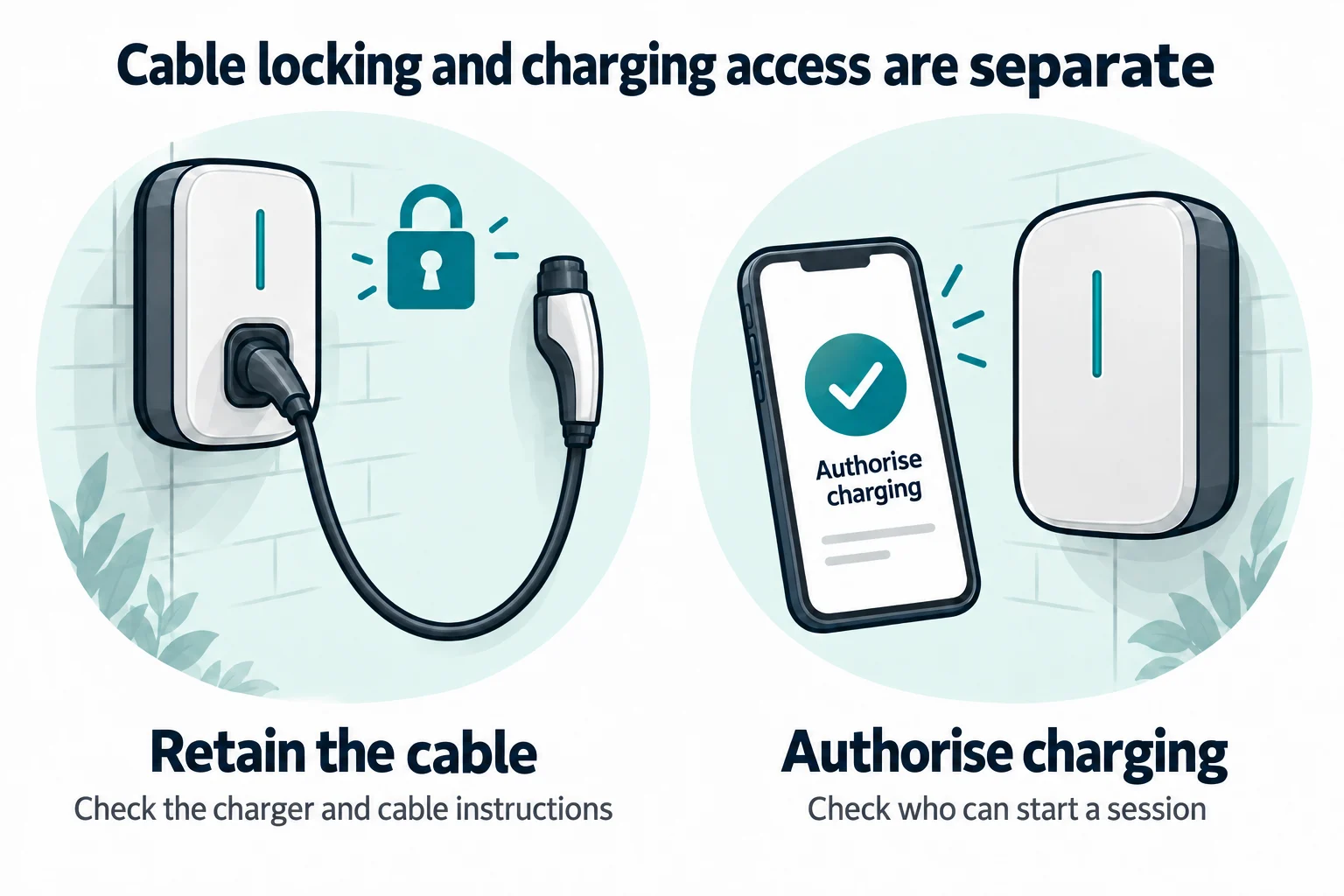
A cable lock is different from charging permission
There are two separate questions: can someone remove the lead, and can someone use the charger? Keeping the wallbox end locked does not by itself answer the second one.
For example, Ohme’s security settings include approval for each plug-in and an option to disable the charger buttons. Those controls govern charging access and physical-button use. They should not be read as confirmation that a detachable lead stays mechanically locked when the car is absent.
Before leaving a cable available on a shared or street-facing driveway, check which access controls your charger provides. Decide who should be able to start a session, then follow the manufacturer’s setup instructions. A setting that suits a private garage may be inconvenient if several authorised drivers use the same parking space.
If a landlord, workplace or charging operator manages the unit, ask them before changing its configuration. Having permission to charge is not necessarily permission to reserve the socket with your own lead.
Read the cable instructions as well as the charger manual
An important counterexample appears in the MENNEKES Mode 3 cable manual. Its English UK instructions describe unplugging after charging, replacing the protective cap and storing the cable in the vehicle. The manual also gives different protection ratings for an unplugged connector and a connected or capped one.
That is why “the charger can lock it” is not enough to establish a suitable long-term storage arrangement. If your lead’s manual tells you to remove it after use, follow that instruction or obtain clarification from its manufacturer for your intended setup.
Look up the actual product reference, not just the logo on the cable. A useful question for support is: “May this cable stay connected to my outdoor socketed wallbox between sessions, with the vehicle end stored in its approved holder?” Include the charger model and describe the location.
Keep the answer with the product documentation. If you later replace the cable, check the new instructions rather than assuming the permission transfers.
Plan the outdoor storage arrangement
Where the instructions allow the lead to stay connected, think through the whole parking routine. Consider where the plug goes when the car leaves, how the cable is supported and who walks past it.
Choose a position for any manufacturer-specified holder that you can use easily without stretching the lead. Check the route with the car in its normal space, then consider the empty driveway: a cable that lies neatly beside a parked car may cross a walking route once that car leaves.
Use the specified protective cap or holder as directed. Do not assume that a decorative hook protects the electrical contacts, or that a rating printed on the wallbox also describes the loose connector. Avoid arrangements that leave the plug in standing water or expose the cable to vehicle wheels.
Build inspection into the routine. Look for damage, contamination or signs of overheating before use. Stop using suspect equipment and contact the manufacturer or installer rather than repeatedly resetting a fault. Leaving the lead in place should not mean forgetting it needs attention.
If you need a longer lead to reach a better storage position, check compatibility before replacing it. Do not improvise a joint or extension to make the existing cable reach.
Is it more convenient than packing the cable away?
That depends on where you charge and who uses the car. Consider these situations before buying extra accessories or choosing your next wallbox:
- Home is your main charging location. Keeping an approved cable arrangement ready may remove a daily unpacking job. Check that storing the loose end is genuinely easier than putting the whole lead away.
- You regularly use socket-only public AC chargers. Your home lead may also be your travel lead. Decide whether you will release and pack it before trips or keep a second compatible cable in the car.
- Several cars share the charger. Check reach and vehicle compatibility for each driver, as well as who can unlock the lead and approve charging.
- The parking space is shared. Agree where the cable can sit and whether leaving it attached prevents others using the chargepoint as intended.
You do not have to choose one routine for every situation. Where permitted, leaving the lead attached during ordinary use and storing it for an extended absence may suit you better than treating “permanent” as an instruction never to remove it.
What happens when you need to take the cable away?
Find the normal release procedure before the first journey on which you will need the lead. Check that the appropriate account holder can access the setting and knows which charger it controls.
Allow time to stop charging and disconnect in the order specified by the vehicle and charger instructions. If the plug will not release normally, stop pulling and use the manufacturer’s troubleshooting route. Contact support if the problem remains; opening the wallbox or interfering with its lock is not a routine owner task.
For a shared household, agree who keeps access to the charger account. For a managed installation, identify the operator’s contact details. A cable that is technically removable is less useful as a travel lead if the only person who can release it is unavailable when you leave.
Does keeping it locked prevent theft?
A retention lock can address someone simply unplugging the cable from the socket. It does not make the exposed length impossible to cut, so do not treat a permanent-lock setting as a theft guarantee.
Choose between leaving the cable available and storing it securely with that limitation in mind. Keep its receipt and identifying details either way. If the lead disappears or is damaged, our stolen EV charging cable replacement guide explains the distinction between buying a detachable replacement and arranging a tethered-charger repair.
If you are still choosing the overall arrangement, our EV charger buying guides cover the wider decision. For an existing socketed charger, make this choice from the exact equipment instructions and your daily routine: confirm that leaving the lead connected is allowed, establish how it locks and releases, and give the unused end a suitable place to live.
Common questions
Does permanent cable locking turn an untethered charger into a tethered one?
It can give you a similar daily routine, because you only handle the car end. The charger still has a socket and a detachable lead, however. Its cable instructions, release procedure and maintenance requirements still apply.
Can I leave the loose vehicle connector outside in the rain?
Follow the cable manufacturer's instructions for an unplugged connector. A rating for a mated connection does not automatically cover an exposed plug. Use the specified cap or holder where required; do not leave the connector in standing water.
Will locking the cable stop someone charging their car?
Not necessarily. Retaining the lead in the wallbox and authorising a charging session are different functions. Check your charger's access-control settings as well as its cable-lock setting.
Should I buy another cable for public charging?
Only if it suits your routine. If you use socket-only public AC chargers, either take your compatible home cable with you or keep another suitable lead in the car. Check what your usual public chargepoints provide before buying a spare.