
Grants
How Long Does an OZEV Grant Approval Take in 2026?
On this page
For the renters and flat owners chargepoint grant, get an installer quote and permissions first, apply next, and wait for approval before installation. There is no fixed processing time in the official application guidance checked on 26 September 2026, so a car delivery date is not a safe basis for assuming approval will arrive.
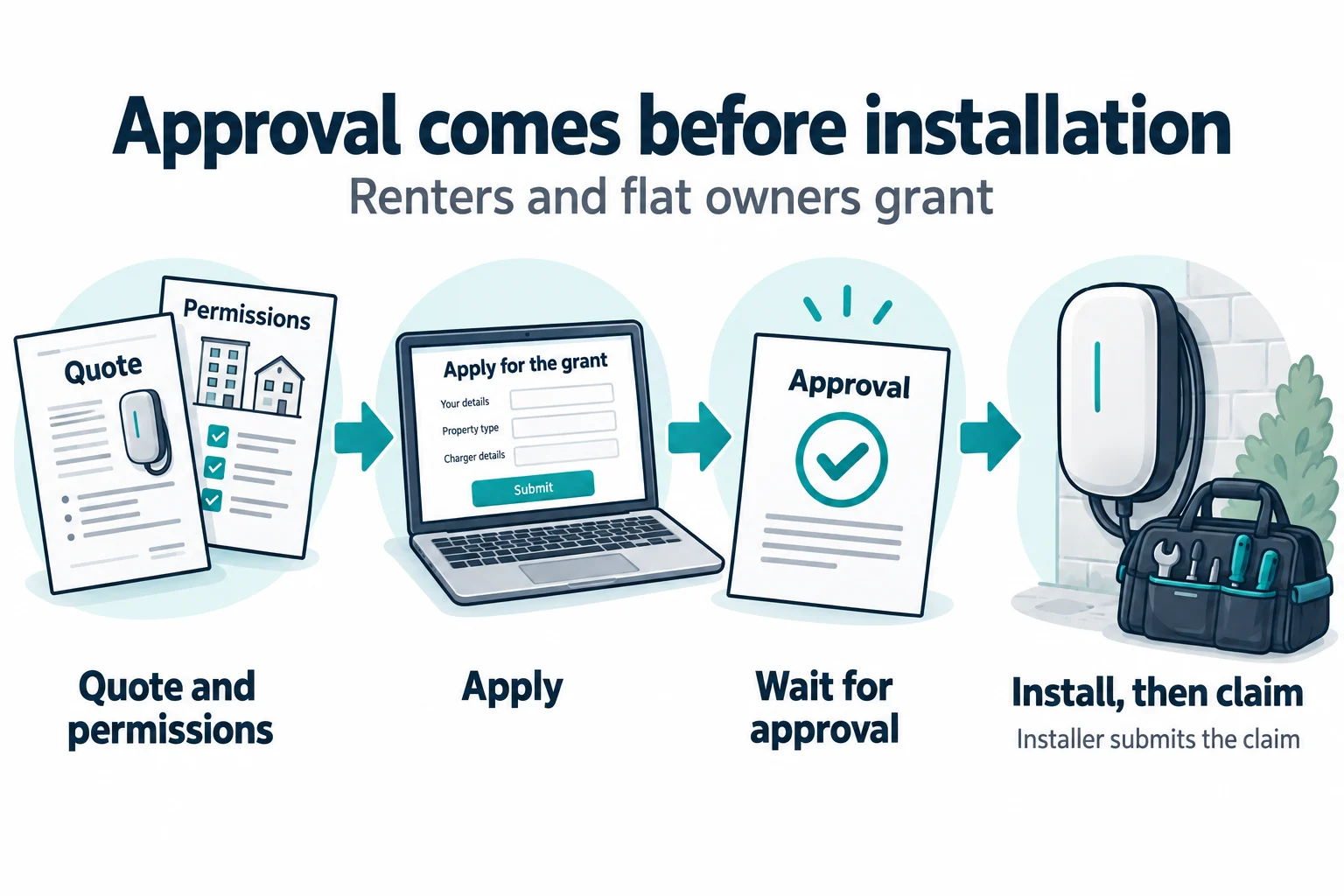
The application order
- Check the scheme eligibility, including your property, parking and vehicle.
- Get a dated quote from an OZEV-authorised installer and the required written permissions.
- Submit the application with the supporting documents.
- Wait for OZEV to notify you and your installer of approval before work starts.
- After installation, the installer submits the claim. Approved funding is paid to the installer.
These are the published application steps. An installer can help you prepare, but submitting an application and the installer’s later claim are different stages.
Planning around an uncertain wait
Keep your car delivery, permission, grant and installation dates in one place. Ask whether the installer’s quote expires and how a provisional booking can be moved. An application acknowledgement is not approval to start work.
If the car arrives first, plan a suitable public or workplace charging option. Our early car delivery guide covers the gap without treating an ordinary domestic socket as an automatic fallback.
How to chase your application
For this scheme, GOV.UK directs applicants to their installer or the Government Grant Managed Service at ggms.flatsandrenters@cabinetoffice.gov.uk. Include your name, application reference and the installer’s business name and OZEV number if available. Use the current help details before sending documents; this address is specific to the renters/flat-owners route.
Different parking, different scheme
Households relying on on-street parking should use the separate on-street grant guidance. Council permission for a permanent pavement solution is an additional part of that route. Workplace and landlord schemes also have separate rules: start with our grants overview.
Funding is not guaranteed merely because an application is pending. Check the terms of any approval and report changes in your circumstances to the scheme administrator. If work has already started, see retrospective applications.
Common questions
Can I apply before choosing an installer?
No. For the renters and flat owners grant you need a dated quote from an OZEV-authorised installer before submitting your application.
Does OZEV promise approval within 30 days?
The application guidance checked on 26 September 2026 does not give a fixed processing time. Do not treat 30 days as a deadline or guarantee.
Can I apply before my car arrives?
An eligible vehicle on order can qualify. You still need the other evidence, permissions and installer quote required by the scheme.
Can I change installer while I wait?
Ask the scheme support team how to amend your application before changing the work or installer. Do not assume an approval transfers automatically.