
Grants
Charging an EV On-Street With No Driveway
On this page
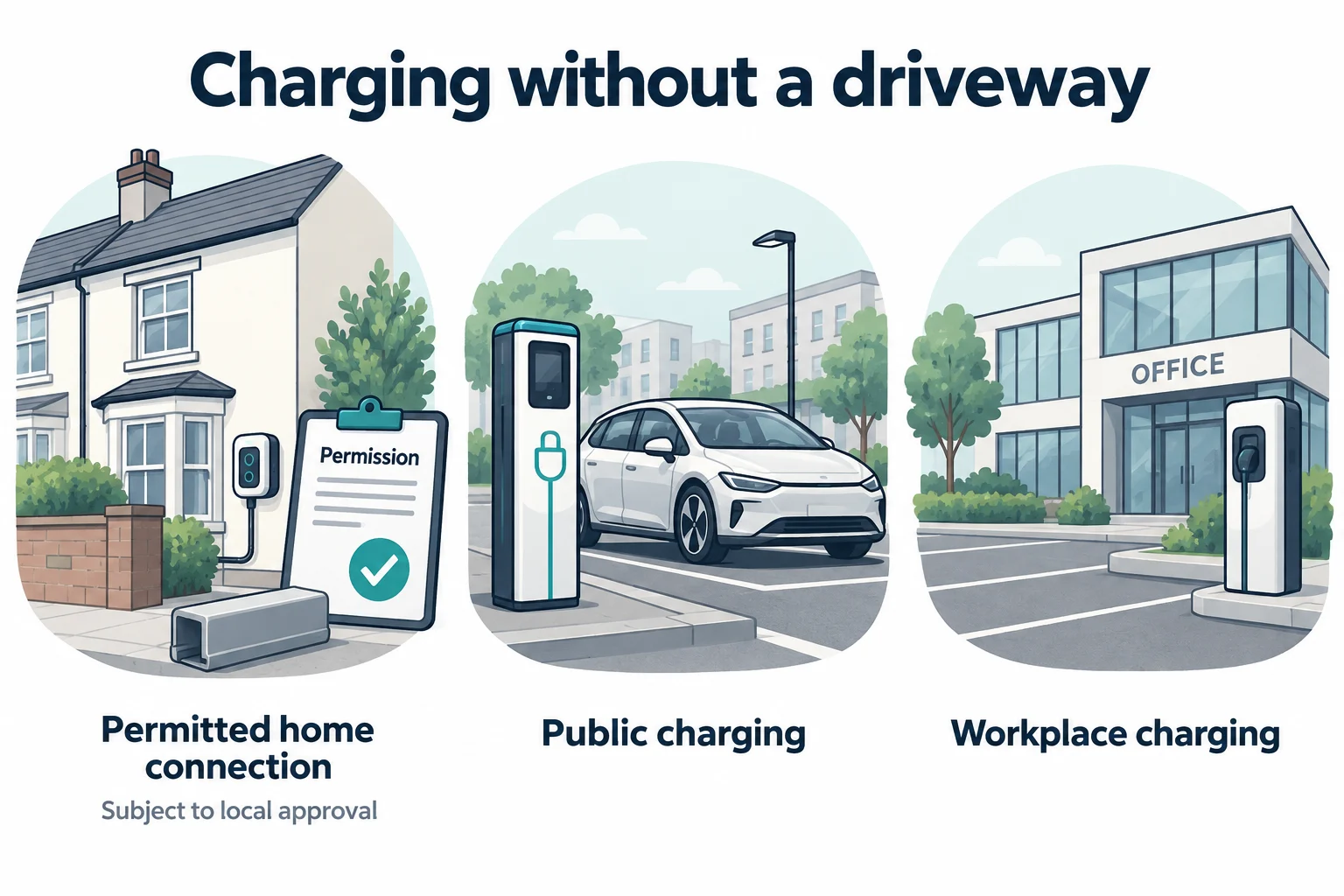
You can own and charge an EV without a driveway, but a cable across a public pavement is not an arrangement to improvise. Start with your local highways authority and a practical alternative charging plan.
Permission depends on where you live
The government’s cross-pavement guidance warns that trailing cables create trip hazards and may breach highway law. The Highways Act 1980 discussion in that guidance concerns England and Wales; do not treat it as a complete account of Scottish or Northern Irish law.
In Northern Ireland, the Department for Infrastructure’s channel guidance addresses requests for permanent channels. Elsewhere, ask the relevant council or roads authority for the applicable process. Local permission, planning and property rights all need checking.
A mat, supervision or a short charging session is not automatic authorisation. Keep pedestrian access in mind, including wheelchair users and people with impaired vision. See the council permission guide for questions to ask.
A permitted permanent channel
A channel can let a cable reach a legally parked vehicle from a domestic chargepoint, subject to approval and the site’s suitability. It does not reserve a parking space. Check who installs and maintains it and what happens if the space outside your home is occupied.
The on-street household grant requires a permanent solution and excludes temporary cable mats. Its chargepoint funding and the council’s permission are separate. Compare the channel options only after checking which products your authority permits.
Public or workplace charging
Check chargers near home, work and places you already visit. Look at connector compatibility, operating hours, parking limits and the tariff shown by the operator. Have an alternative location rather than depending on one chargepoint always being available.
Your council may accept suggestions for public charging locations, but a request is not a promise of a charger outside your home. Local funding schemes also differ across the UK.
Compare the complete cost
For a home connection, include the channel, permissions, chargepoint and installation as well as electricity. For public charging, include parking or session fees where applicable. Use our 400-mile worked example with your own rates; it is not a prediction of your bill.
Common questions
Does a rubber cable cover make pavement charging permitted?
Not automatically. Check your highways authority’s policy. Temporary mats do not meet the permanent-solution condition of the household on-street chargepoint grant.
Can I charge across the pavement briefly while watching the cable?
Do not assume a short duration or supervision gives permission or removes the risk to pedestrians. Arrange an approved solution or use another charging location.
Where can I check council permission?
Use our council permission guide and then the responsible authority’s current policy for your address.
Will insurance cover someone tripping over the cable?
Ask your insurer about your exact arrangement and liability cover. A policy does not itself grant highway permission, and this guide cannot confirm cover.