
Grants
Cross-Pavement EV Charging: Council Permission Guide
On this page
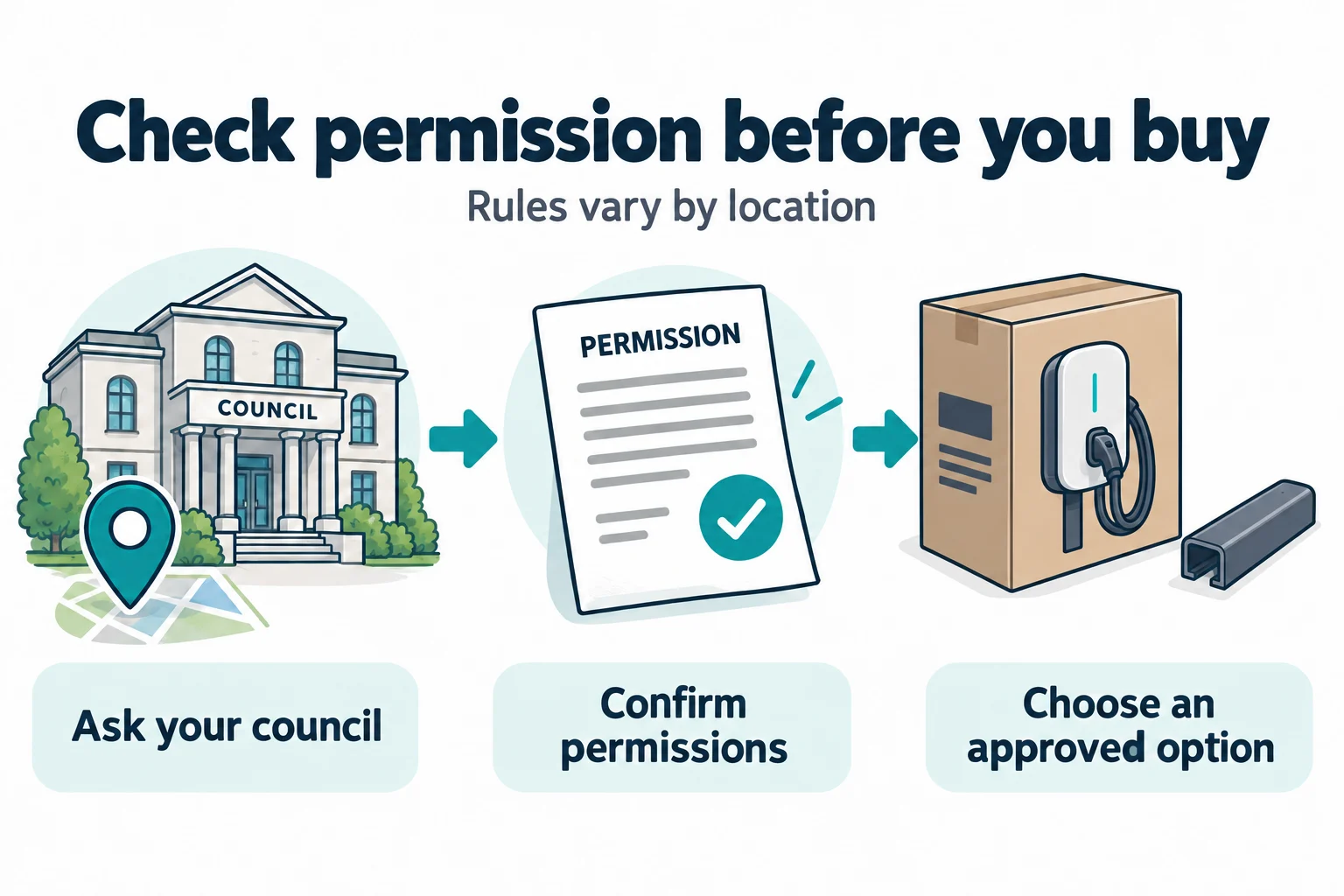
Start with your council’s policy before buying a cross-pavement charging channel. Permission, permitted products, fees and who installs the channel vary locally; a national charger grant does not approve work on the pavement.
Examples of local approaches
These are selected examples checked on 26 September 2026, not a national eligibility checker. Follow the linked policy for the full conditions and current availability.
| Authority | Published position | Costs and next step |
|---|---|---|
| Hertfordshire / St Albans trial | Trial application process with property and parking requirements | £200 non-refundable assessment; installation normally £1,200 after the stated channel subsidy, with exceptions. Check the trial’s eligibility form. |
| Cornwall | Application route for an EV channel licence | Published licence fee £184; eligible channel fitting can receive local funding. Check the current conditions and fees before applying. |
| North Northamptonshire | Trial to be launched; no adopted policy currently enabling this home-charging arrangement | The council says application, cost and licence details will follow. Do not treat a planned trial as permission to install. |
For an authority not listed, use its own current website and ask for written confirmation. Scottish and Northern Irish permission processes need checking with the responsible local authority; do not infer their rules from these English examples.
Separate the charger grant from the pavement project
The households with on-street parking grant offers up to 75% of eligible chargepoint purchase and installation costs, capped at £500. It requires an authorised permanent pavement solution, suitable on-street parking and the relevant permissions. It is available across the UK subject to its conditions, not just England.
For example, £500 eligible cost × 75% = £375 grant. At £1,000 of eligible cost, the £500 cap applies. Neither example means the whole bill is covered.
Ask for separate quote lines for the chargepoint, channel, highway work, permits and any ongoing obligations. Government cross-pavement guidance distinguishes channel work from the resident’s chargepoint purchase. Do not assume the charger grant pays every part of the pavement project; ask which funding covers each line. Where an older general guidance page still shows an earlier grant amount, use the current scheme page linked above for the rate.
Questions for your authority
- Is there an open scheme for my exact address and parking arrangement?
- Which products and contractors are permitted, and who arranges the work?
- Which highway, planning and property permissions are required?
- What is payable before a decision, what is refundable, and what local funding is available?
- Who maintains the channel, carries liability and deals with damage?
Keep the answers and approval documents. Highway and planning decisions can involve different teams; neither replaces landlord or freeholder permission where required.
If a channel is not available
Ask the authority for the reason and any review or future-trial route it offers. Meanwhile, assess nearby public or workplace charging. Our charging without a driveway guide explains the options and geographical limits of the legal guidance.
Common questions
Can I lay a charging cable across the pavement?
Do not assume you can. Ask the responsible highways authority about its rules and approved arrangements. A temporary cover is not automatic permission, and it does not qualify as the permanent solution required by the on-street grant.
Does the £500 grant cover the whole installation?
No. It is capped at 75% of eligible chargepoint costs and £500, whichever is lower. At £500 of eligible costs, the grant would be £375, leaving £125, plus any costs outside the grant.
What if I rent?
You need the relevant property permissions as well as highway consent. Check the requirements for your landlord, freeholder or property manager before applying.
Does council consent reserve the parking space?
No. A permitted channel does not give you ownership or guaranteed access to the public parking space outside your home.