
Charging technology
OZEV-Approved Installer vs Electrician: The Difference
On this page
OZEV authorisation allows an installer to participate in the relevant government chargepoint grant schemes. It is a separate check from electrical competence, building-regulations certification and manufacturer approval. If you are paying privately, focus on whether the electrician can competently assess, install, test and certify your EV charger. If you are using an OZEV grant, verify the required authorisation as well.
Guidance checked on 11 October 2026. This guide is for choosing a home-chargepoint installer, not for carrying out electrical work. It has not received independent electrical-professional sign-off.
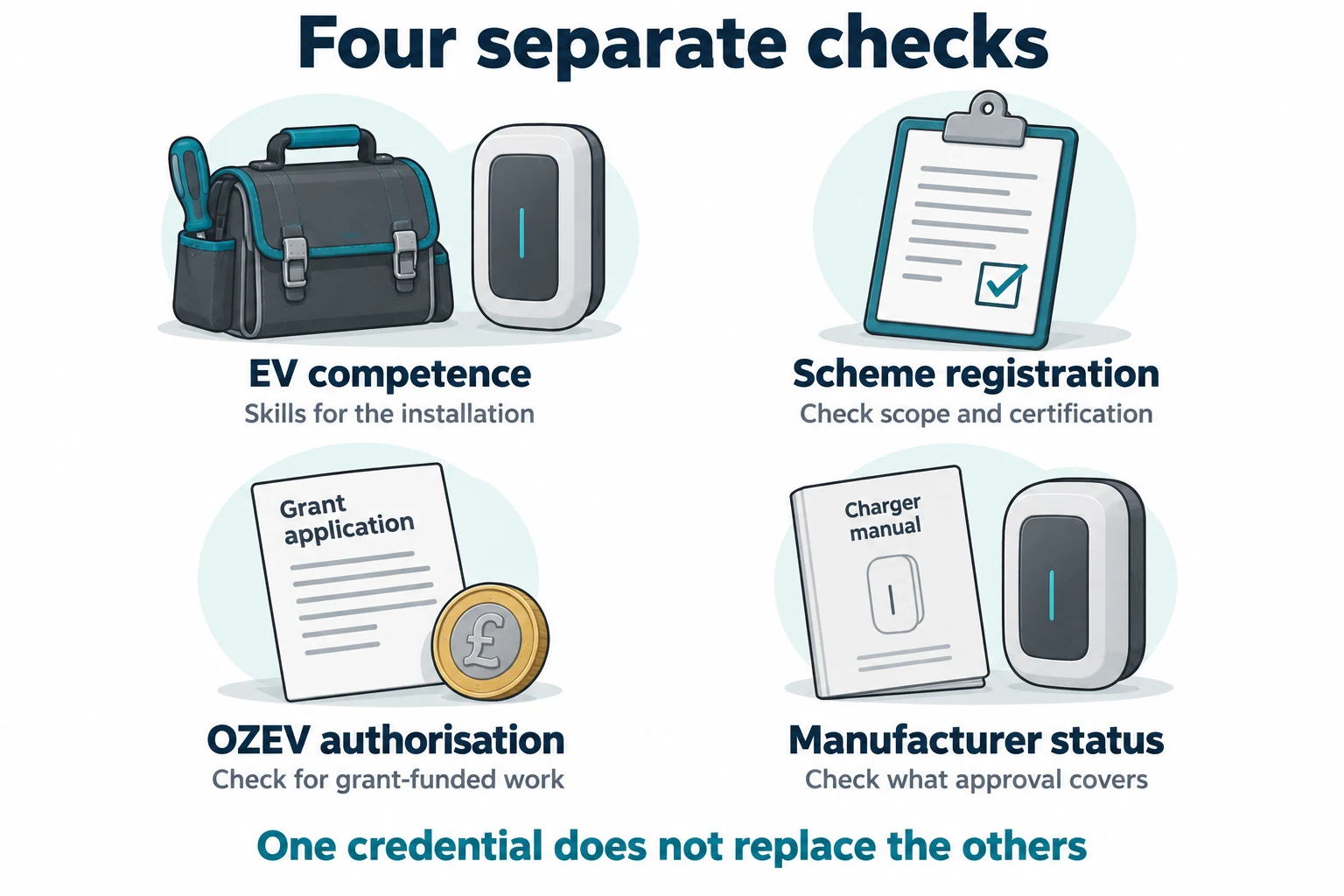
What the different credentials tell you
An electrician can hold several of these credentials at once. “OZEV installer” and “electrician” are not mutually exclusive occupations.
| Check | What it establishes | What you still need to ask |
|---|---|---|
| EV installation competence | Relevant training, skills and experience for chargepoint work | Can they assess your supply, choose suitable protection, follow the charger’s instructions and test the installation? |
| Electrical scheme registration | Membership of a particular scheme, with a defined scope | Does that scope cover the work and the proposed certification route? Verify the registration directly. |
| OZEV authorisation | Participation in the applicable chargepoint grant arrangements | Are the business and installation eligible under the specific scheme? Check current status. |
| Manufacturer installer status | A relationship with a particular charger manufacturer | What does that manufacturer’s approval cover, and what are the installation and warranty conditions? |
Electrical Safety First recommends an electrician trained and qualified for EV chargepoint work. A general electrical qualification or a logo on a van should start the conversation, not finish it.
What OZEV authorisation adds
OZEV is the Office for Zero Emission Vehicles. Its installer authorisation guidance describes the information and electrical-scheme or association credentials required to apply. Authorisation can be suspended or withdrawn, so an old claim of approval is not enough.
The grant arrangements also bring responsibilities for eligible equipment, installation records and claiming the funding. The status is useful when you need a grant, but it does not guarantee your household qualifies or that every charger offered by the business is eligible.
Use the official EV chargepoint installer service to check the business. Ask for its OZEV number and confirm who will actually carry out the work, particularly if the seller uses subcontractors.
If you are claiming a grant
Identify the scheme before booking the installation. The renters or flat owners application process requires a quote from an authorised installer, the necessary permissions and an application. Work starts after approval. The installer claims the grant after completing the installation.
That order matters. Do not accept “we will sort out the grant afterwards” as a substitute for the scheme’s approval process. Keep the quote, permission documents, approval and final invoice together, and make sure the model and installer details match what was agreed.
Other schemes have their own conditions. Our UK EV charger grant guide explains the main routes; confirm the current rules for the one you intend to use.
If you are paying without a grant
You still need a properly assessed and tested installation. Ask the electrician to explain the work included in the quote, any supply limitations, the protection required and the paperwork you will receive.
Building-regulations arrangements depend on where you live. In England, Approved Document P covers domestic electrical safety and explains notification and certification. Do not assume an OZEV listing handles that process or that England’s procedure applies throughout the UK. Agree the applicable route before work begins.
The electricity network process is another separate item. Ask who handles any required DNO application or notification and what evidence you will receive. See our DNO notification guide and home installation explainer for those distinctions.
Compare the full installation, not just the headline price
A useful written quote should make it possible to compare the same job across installers. Ask for:
- The exact charger and included equipment. Confirm the cable arrangement and any accessories you expect.
- The installation scope. Establish the cable route, any groundworks, proposed protective equipment and the treatment of work outside the quoted scope.
- The compliance responsibilities. Identify who handles electrical certification, applicable building-regulations procedures and the network process.
- The handover and support. Confirm that commissioning, basic operating guidance and responsibility for faults are clear.
- The grant treatment, if relevant. Make the total price, your contribution and the conditions attached to funding explicit.
These are questions for obtaining comparable quotes, not a claim that every property needs the same work. A price difference may reflect a different cable route, equipment or scope; ask for the explanation before deciding that one installer is better value.
Before paying a deposit, verify the credentials claimed and get the scope in writing. Use the EV charging technology hub to prepare questions about the installation itself.
Common questions
Do I need an OZEV-approved installer without a grant?
OZEV authorisation relates to participation in its chargepoint grant schemes. A privately funded installation still needs an electrician competent in EV work, appropriate electrical certification and compliance with the applicable building and network requirements. OZEV status does not replace those checks.
Is NICEIC or NAPIT registration the same as OZEV approval?
No. Electrical scheme registration and OZEV authorisation have different purposes. Verify the electrician's claimed registration with its scheme, then separately check the official OZEV installer service if your grant requires it.
Can my usual electrician install an EV charger?
They may be suitable if they have the competence for EV installation and can deliver the required assessment, testing and certification. Ask about their EV qualifications, experience with the chosen charger and the compliance route for your property. Familiarity with other electrical jobs alone is not enough.
Can I install first and arrange the grant afterwards?
For the renters or flat owners grant, the official process requires approval before installation starts. An inspection afterwards or a later change of installer should not be treated as a way to make an earlier installation eligible. Check the rules of the specific scheme before work begins.