
Charging technology
Do You Need to Notify Your DNO for an EV Charger?
On this page
Yes - but the reassuring part is that it’s not something you have to chase yourself. If you’re getting a proper installation, notifying your Distribution Network Operator is a standard part of the job your installer does, not an extra step you need to arrange.
What a DNO is, and why a charger needs one
Your DNO is the company responsible for the electricity network in your local area - not your energy supplier, which is who bills you, but the operator of the physical wires and substations that deliver power to your street. An EV charger typically draws a sustained 32-amp load, which is a meaningfully larger and longer draw than most household appliances. Multiply that by enough houses on a street installing chargers around the same time, and it’s exactly the kind of change a network operator needs visibility on to make sure local capacity can handle it.
The paperwork, briefly
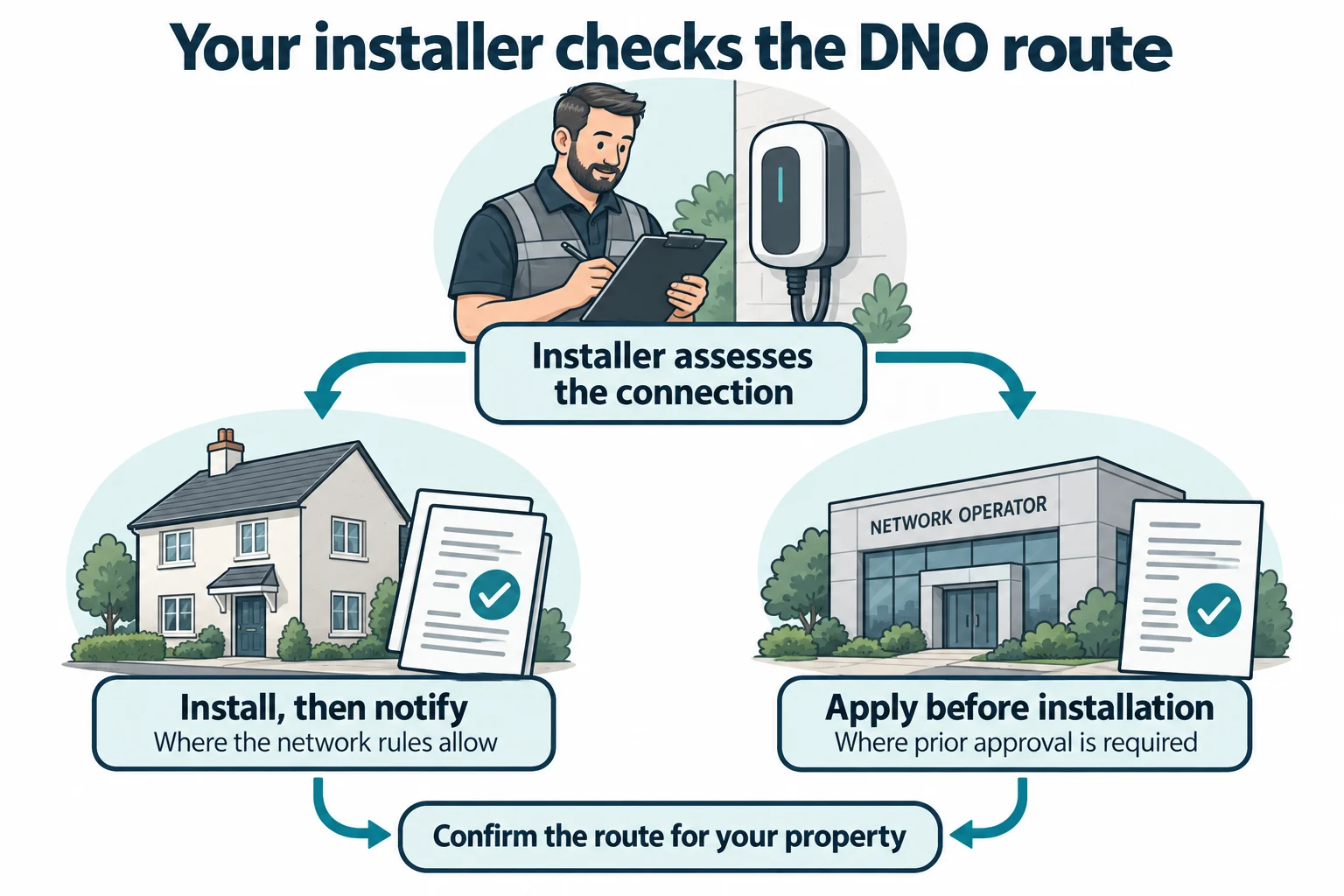
It’s worth clearing up a mix-up that shows up a lot in EV forums: G98 and G99 are real Energy Networks Association standards, but they cover generation and export equipment - solar panels, batteries, anything that can feed power back into the grid. A standard EV charger that only draws power doesn’t fall under either one. What DNOs actually use for a plain domestic charger is a dedicated EV charge point application process - Electricity North West’s single-EV connection page is a clear worked example: straightforward installs go through a “Connect and Notify” form submitted after the work, while anything more complex (higher load, three-phase, or export-capable equipment like V2G) needs the same form submitted before installation for approval. The exact process and contact details vary slightly by DNO, but the notify-after vs. apply-before split is the standard shape nationwide.
Who actually does this
Your installer. Part of what you’re paying for in a proper installation - as opposed to an unregistered or DIY job - is exactly this: the paperwork trail that confirms the installation was notified correctly. If you’re getting quotes and want a quick way to gauge whether an installer is doing things properly, asking directly “how do you handle the DNO notification for this job” is a reasonable question, and a competent installer should answer it without hesitation.
What happens if it’s skipped
An unnotified high-load connection is a genuine risk to local network stability if enough of them accumulate unnoticed, which is the whole reason the requirement exists. On an individual level, skipping it - as can happen with informal or DIY installations - also tends to unravel other protections: it’s difficult to have a fully compliant, insurable installation without the paperwork trail that notification is part of. It’s one more reason a cut-price, unregistered install rarely turns out to be the bargain it looks like upfront.
For the separate competence and building-control questions, see can you install your own EV charger?.
Common questions
I already have solar panels or a home battery - does that change anything?
Possibly. Solar and battery systems are generation/export equipment, which is exactly the territory G98 and G99 cover. Adding an EV charger to a property that already has one of those installed can push the combined setup into needing a fuller application rather than the simple notify-after route, since the DNO needs to see the whole picture, not just the new charger in isolation. Tell your installer about any existing solar or battery system upfront rather than letting them find out partway through the quote.
Does a slower 7kW charger still need notifying?
Yes. Notification is about the connection itself, not how fast the charger happens to run day to day - a 7kW single-phase unit still goes through the same process as a faster one, just typically via the simpler notify-after route rather than a full pre-approval application.
What if I'm replacing an old charger with a new one, like-for-like?
This is worth asking your installer about directly rather than assuming it's exempt. Even a straight swap changes what equipment is connected, and DNO records are tied to what's actually installed at a property - a competent installer will know whether your specific replacement needs a fresh notification or not.
How would I know if my street already has a capacity problem?
You generally wouldn't, in advance - this is precisely what the DNO notification process exists to catch. It's not something to worry about pre-emptively; it's the reason the paperwork step exists at all, and it's the DNO's job to flag it if your specific connection is an issue, not yours to predict.